Value-Added Course in Modeling Practice for Automotive Assemblies using SolidWorks
The Department of Mechanical Engineering, Selvam College of Technology, successfully organized a Value-Added Course titled “Modeling Practice for Automotive Assemblies using SolidWorks” from 26.10.2026 to 30.10.2026. The programme was conducted for a total duration of 30 hours, structured as 6 hours per day over five days, with a strong emphasis on practical and application-oriented learning.
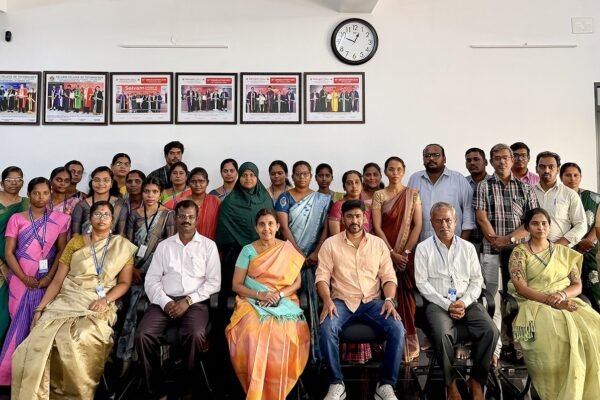
Dr.S.Babu, Chairman of Selvam Educational Institutions, presided over the function. The VAC was conducted in the presence of Dr.B.Kaviethra Nandhini, Secretary of Selvam Educational Institutions, Mr.M.Karthik, Executive Director, and Dr.S.Ramabalan, Principal of SCT, and Dr.G.Selvaraj, Head of the Department of Mechanical Engineering, who welcomed the participants and emphasized the importance of modelling and assembly skills in the field of automotive engineering.
The sessions were effectively delivered by Er.V.Prabhakar, M.E. (CAD/CAM), Application Engineer, Institute of Engineering Design, Salem. He provided in-depth training on SolidWorks software with a focus on automotive applications. The course content included:
- Fundamentals of Computer-Aided Design (CAD)
- SolidWorks Interface
- Sketching Fundamentals
- 3D PART MODELLING – Basic Features, Advanced Part Features
- ASSEMBLY MODELLING – Assembly Environment, Assembly Practice
- ENGINEERING DRAWINGS – 2D Drawing Creation, Drawing Standards & Output
- Model Modification & Evaluation
- Industrial case demonstrations and design practices
- Hands-on exercises, assignments, and mini-project development
The participants actively engaged in all sessions and successfully created various part models and automotive assemblies. The hands-on approach enabled students to gain practical exposure and develop competencies in product modelling, assembly design, and technical documentation.
The programme significantly enhanced the students’ proficiency in SolidWorks and strengthened their confidence in addressing real-time design challenges in the automotive and manufacturing sectors. A total of 61 second-year students benefited from the programme. The Department sincerely acknowledges the dedicated efforts of the resource persons and appreciates the enthusiastic participation of the students, which contributed immensely to the successful completion of the programme.